AI Competence Framework for University Teachers
Artificial Intelligence (AI) is fundamentally changing higher education. Teachers are not only expected to use new tools but also to critically assess their potential, limitations, and implications. The AI Competence Framework for Teachers supports teaching staff in developing a deep understanding of the diverse applications of AI and in deploying it purposefully to enhance teaching and learning processes. It promotes critical engagement with both the opportunities and challenges of AI, and encourages the continuous development and application of innovative AI-supported methods and tools in university teaching. Moreover, it aims to empower educators to guide students in using AI in a reflective, competent, and responsible manner – in particular, to foster active, self-directed learning.
It is essential that the impacts and implications of AI are always considered in the context of one's own discipline and integrated into it. This ensures a well-founded and practice-oriented application of AI that meets both the specific requirements of the field of study and the overarching didactic, ethical, and data-protection standards.
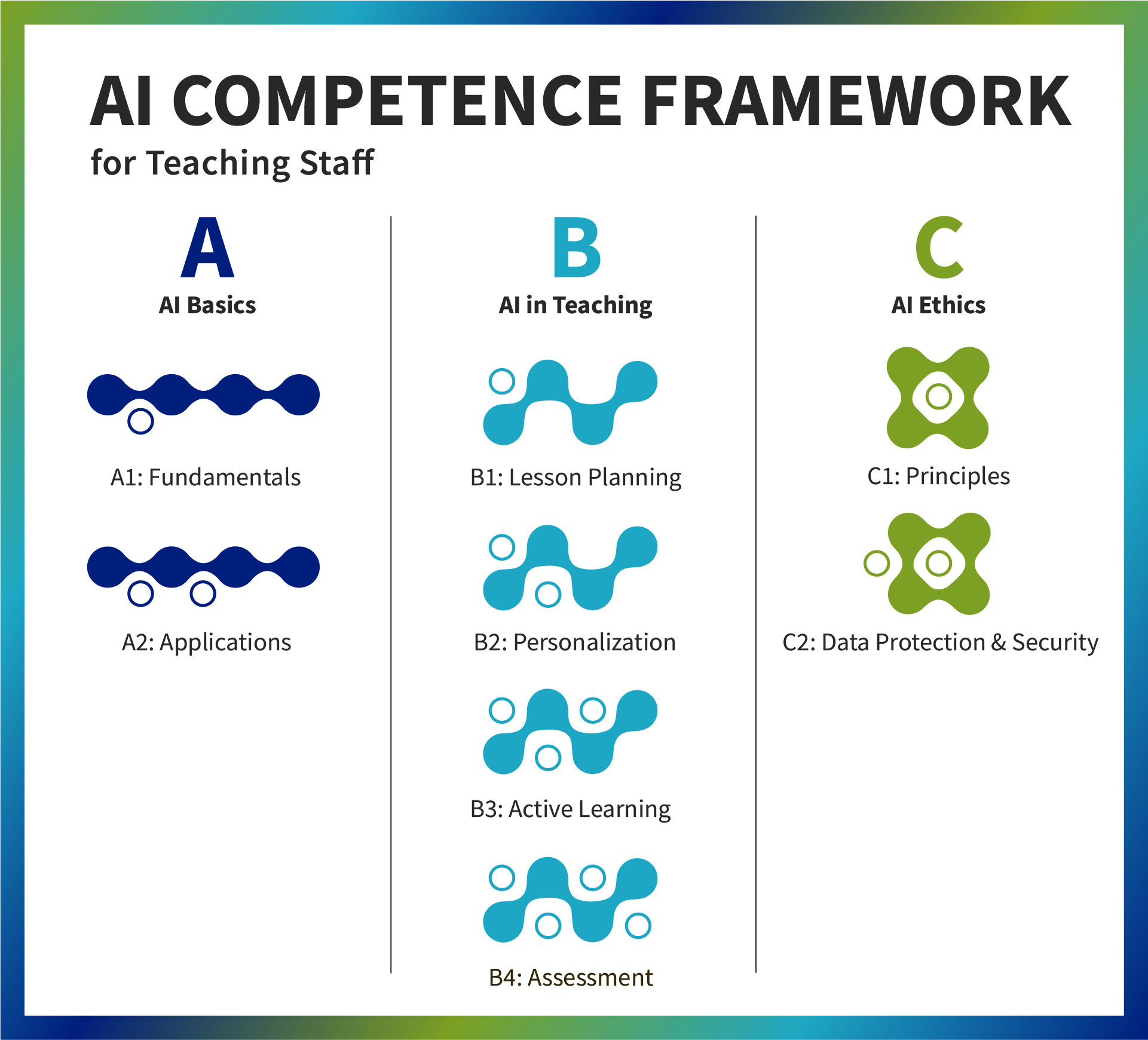
Overview Competence Areas
Your benefit as university teacher
- Orientation: The AI competence framework structures AI competencies in a clear and practical way.
- Self-reflection: It helps you assess where you currently stand.
- Professional development: It shows pathways from foundational knowledge to innovative use.
- Responsibility: Ethical and legal questions are an integral part.
Area A: Understanding AI and its Applications

Teaching Staff acquire sound knowledge of the fundamental definitions and workings of AI in order to develop an in-depth understanding of training processes and application methods. They master various AI concepts and critically analyze AI systems in real-world application contexts.
Subcompetence A1: Fundamentals of Artificial Intelligence
Develop a foundational understanding of how AI systems work, how they are trained, and how they differ from other digital technologies. You will learn to assess the possibilities and limitations of various AI technologies and to critically reflect on their significance for teaching and research.
Subcompetence A2: Application areas of AI

Get to know different AI applications and identify possibilities for using them in your own discipline. You will develop the skills to select and use AI applications, assess their added value, and critically review AI-generated results.
Competency Area A "AI Basics" - Resources
The resources are continuously being developed and regularly expanded with new content and materials.
| Resource |
Short description |
| Teaching Tool on AI in Higher Education Teaching |
This tool offers an introduction to the significance of generative AI and large language models for teaching and learning at universities. Link to resource: Link to Teaching Tool |
| Self-paced course: UZH AI for Teaching |
This unit covers what AI is and explains central concepts such as machine learning, deep learning, and generative AI. Through hands-on work with AI tools, their possibilities are explored and the origins of the generated results are reflected upon. Link to resource: Link to OLAT |
| Overview on AI tools and services at UZH |
An overview from UZH's Central IT Services provides information on available and planned AI tools and services, as well as their approval status and permitted data classifications. Link to resource: Link to overview |
| ZI Lunch Session: Why Doesn't AI Always Understand Me? (recording) |
This lunch session teaches how you can use AI tools efficiently and effectively in your daily work, particularly through effective prompting, working with AI-assisted texts and data, and the critical evaluation of AI-generated results. Link to resource: Link to lunch session |
| Information Page on Microsoft Copilot at UZH |
This information page provides UZH members with an overview of the available Copilot versions, their features, costs, and access conditions. Link to resource: Link to information page |
Area B: Designing AI-Supported Teaching and Learning

University teachers develop comprehensive knowledge and skills in applying AI to support lesson planning and preparation, to personalize and differentiate instruction, to promote engagement and active learning, as well as to create, administer, and assess performance evaluations. They systematically deploy innovative AI tools, critically reflect on their use, and design tailored learning environments that meet the individual needs of students and continuously improve the quality of teaching.
Subcompetence B1: Lesson Planning
Use AI in a targeted way to plan and prepare your teaching, as well as to create and adapt teaching and learning materials. You will learn to integrate suitable AI tools into your planning processes, try out new AI-supported approaches, and critically reflect on their added value for efficient and pedagogically sound lesson planning.
Subcompetence B2: Personalization
Use AI in a targeted way to take account of students' different learning prerequisites and needs and to adapt learning offerings accordingly. You will learn to use suitable AI tools for personalization and differentiation, assess their effectiveness, and design AI-supported learning environments oriented toward learners' needs.
Subcompetence B3: Active Learning
Use AI in a targeted way to activate students and foster interactive, collaborative, and reflective learning processes. You will learn to integrate AI tools meaningfully into learning activities, adapt them to different needs, and design learning settings that support active learning and critical thinking.
Subcompetence B4: Assessment
Use AI in a targeted way in the design, administration, and assessment of performance evaluations. You will learn to integrate suitable AI tools meaningfully into assessment processes, adapt existing examination formats to new circumstances, and critically reflect on the possibilities, limitations, and implications of using AI for capturing and evaluating student learning achievements.
Competency Area B "AI in Teaching" - Resources
The resources are continuously being developed and regularly expanded with new content and materials.
| Resource |
Short description |
| Teaching Tool AI in Higher Education Teaching |
This tool offers an introduction to the significance of generative AI and large language models for teaching and learning at universities. Link to resource: Link to Teaching Tool |
| Teaching Tool AI and Assessment |
This tool provides an overview of the impact of generative AI on assessments. Link to resource: Link to Teaching Tool |
| Teaching Tool on AI and Feedbeack |
This tool demonstrates how generative AI can be integrated as a feedback partner into teaching and learning processes. Link to resource: Link to Teaching Tool |
| Teaching Tool on the five phases of assessment |
The model shows how AI can be used in the different phases of an assessment. Link to resource: Link to Teaching Tool |
| Good Practice: AI_d - a Chatbot for Developing Contructively Aligned AI Use Guidelines |
The example shows how a chatbot can be used to develop clear guidelines for the use of AI in a course, so that students' learning objectives and learning process remain the focus. Link to resource: Link to Teaching Tool |
| Self-paced course "UZH AI for Teaching", unit on lesson planning |
This unit addresses how AI can support the planning of courses. This includes formulating clear learning objectives, selecting appropriate content, and designing engaging learning processes. Link to resource: Link to OLAT |
| Self-paced course "UZH AI for Teaching", unit on assessment |
This unit addresses how AI can be used to create exam tasks and questions, and how to ensure that these tasks align with the principle of constructive alignment. Link to resource: Link to OLAT |
| Klicker-Tool: AI-enhanced Learning |
Concrete application examples show how AI can be used in KlickerUZH to create exercise content, provide formative feedback, and power chatbots for individual learning support. Link to resource: Link to Klicker |
Area C "AI Ethics": Using AI Ethically and Responsibly
Develop a deep understanding of the ethical principles and data protection requirements involved in using AI, so that you can implement these principles and measures in your teaching practice and promote high ethical standards.
Subcompetence C1: Principles

Develop an understanding of ethical principles and legal frameworks governing the use of AI. You will learn to identify and assess ethical opportunities, challenges, and risks, and to responsibly integrate ethical principles into your own teaching and research practice.
Subcompetence C2: Data Protection & Security

Develop an understanding of data protection and security requirements when using AI. You will learn to identify and assess potential risks, apply data protection and security principles in your own practice, and use AI tools responsibly and in compliance with data protection regulations.
Competency Area C "AI in Ethics" - Resources
The resources are continuously being developed and regularly expanded with new content and materials.
| Resource |
Short description |
| UZH Guiding Principles on the Use of AI |
The seven guiding principles form the overarching framework for the responsible, transparent, and academically sound use of AI in research and teaching at UZH. Link to resource: Link to guiding principles |
| Information Security Guidelines |
The page summarizes the key principles for the responsible and compliant use of AI systems at UZH. Link to resource: Link to information security guidelines |
| ZI Lunch Session: What Can I Dow with AI at UZH? (recording) |
This presentation offers an introduction to the legal and ethical frameworks for using AI at UZH, particularly regarding data protection, responsibilities, and limits of use. Link to resource: Link to lunch session |
| Teaching Tool on responsible AI Use in Higher Education |
This teaching tool supports reflection on the responsible use of AI in teaching. Link to resource: Link to Teaching Tool |
The AI Competence Framework for University Educators was developed as part of the swissuniversities program "Open Education & Digital Competencies (PgB 2025–2028)" within the project "AI Competence Hub," in a collaboration between the University of Zurich and ETH Zurich.
AI Competence Framework for University Educators © 2025 by ETH Zurich and University of Zurich is licensed under CC BY-SA 4.0.
Background information on the AI competence framework
The AI Competence Framework for University Educators is grounded in the theoretical AI-PACK framework, which systematically describes AI-related competencies building on TPACK and DPACK. The framework translates this model into concrete fields of action and developmental stages for higher education teaching.
The TPACK model connects content knowledge, pedagogy, and technology. The DPACK model broadens the concept of technology toward digitality competence—the ability not only to apply digital phenomena but also to critically reflect on and actively shape them. The AI-PACK model carves out AI as a distinct area. It distinguishes three dimensions:
- AI-PK: pedagogical AI competence (e.g., designing teaching and learning processes with and about AI)
- AI-CK: disciplinary AI competence (e.g., the influence of AI on one's own discipline and professional field)
- AI-PCK: AI pedagogical content competence (e.g., the didactically informed use of AI tools in subject teaching)
This makes it clear: AI competence is not merely technical know-how, but always the connection of disciplinary expertise, didactics, and societal responsibility.
The AI-PACK model defines the competencies educators need in the age of AI. The AI Competence Framework for University Educators translates this theoretical model into concrete fields of action and developmental stages for higher education teaching.
The result is a tool that is equally well-founded and practice-oriented—one that enables educators to integrate AI into their teaching in a responsible, reflective, and creative way.
Courses & Workshops
Community of Practice
The subcommunity of practice “AI in Higher Education Teaching” organizes different hands-on workshops and events around the topic of AI in teaching and learning. Find an overview of the planned events here.
Didactica
Didactica is a joint professional development program offered by the University of Zurich and the ETH Zurich, aimed at enhancing the teaching skills of university faculty and staff. These includes the following courses on the topic of AI in teaching and learning:
- AI in Higher Education Teaching: Fundamentals and Practice
- Constructive Alignment with generative AI
- Feedback in the Age of Artificial Intelligence
- Integrating AI-based tools in teaching and learning