AI-related Projects in Higher Education
AI Competence Hub
The rapid, ongoing pace of Artificial Intelligence (AI) developments has highlighted its importance across a wide range of fields. This also applies to university teaching at the University of Zurich and the Swiss Federal Institute of Technology Zurich (ETH Zurich). Teaching staff are expected to enhance their competencies regarding the use of AI in education and, at the same time, be empowered to support students in developing a responsible approach to AI.
The AI Competence Hub project, implemented in collaboration with ETH Zurich, addresses this need and aims to strengthen the AI competencies of teaching staff, taking into account technological, scientific, and social dimensions (project duration: January 2025 to September 2026).
The initiative comprises three closely interconnected components. The “AI Community for Teaching” and the “AI Environment for Teaching Staff” are funded by the swissuniversities PgB program “Open Education & Digital Competencies and are carried out in collaboration with ETH Zurich.Support for teaching staff is provided through an AI competence framework, collaborative Communities of Practice, and specially trained student AI Coaches.
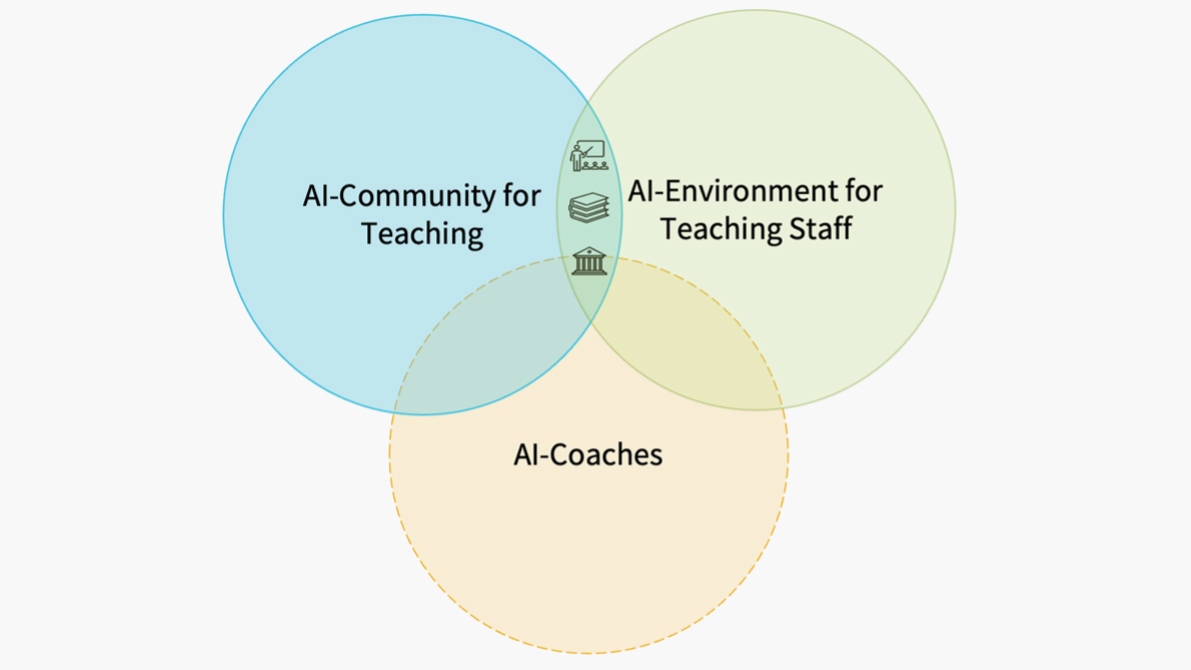
Milestones so far:
1. AI Environment for Teaching Staff
- AI Competence Framework: Developed to support teaching staff in enhancing their AI-related skills and to provide structured guidance for integrating AI into teaching and learning.
- Didactic Resources on Generative AI: helpful didactic resources on the use of generative AI in higher education teaching.
- Introductory Course on AI in Teaching: “UZH KI für die Lehre / AI for Teaching” : an online, self-paced course available in English and German, offering a foundational introduction to using AI in higher education teaching. Access is limited to UZH teaching staff.
2. AI-Community for Teaching (click here to register)
The establishment of a Community of Practice on the topic of AI in teaching and learning at the University of Zürich aims to foster the development of application scenarios and the exchange of knowledge. If you would like to join the community and receive updates and information about community events, click the link above.
In August 2025, the AI in Teaching Forum marked another major milestone. The forum brought together more than 100 participants from over 19 institutions across Switzerland. It provided practical insights into the use of AI in teaching while also enabling discussion of key questions, such as the role of AI in assessment.
3. AI Coaches
The course Start! AI Competences (for Teaching & Learning) was developed at the University of Zurich. Through this course, students are qualified as AI Coaches. These specially trained students support lecturers in the use of AI in higher education teaching. Starting in the Spring Semester 2026, the first 12 student–lecturer tandems will begin their collaboration.
In 2026, the plan is to further advance the initiatives in all three areas: by developing AI resources to foster AI competencies, strengthening the AI community through various event formats, and continuing and expanding the AI Coaches program.
AI Tools and Services for Teaching
Klicker supports teaching staff in integrating AI into teaching and assessment through a range of practical use cases :
All of these build on a shared content-understanding layer: KlickerUZH turns a course’s materials, including videos, documents, and websites, into knowledge graphs that map how its concepts connect. The AI features work from this representation, so they stay close to what is actually taught rather than to generic knowledge.
AI-generated Practice Content : KlickerUZH generates practice questions from your existing course materials, in every supported format (single/multiple choice, Kprim, free-text, numerical) and across the levels of Bloom’s taxonomy. Lecturers review and edit the questions before publishing, so preparation takes less time without gaps in coverage.
AI-assisted Formative Feedback: Students get immediate feedback on open-ended questions at any time of day. It shows what’s strong and what to improve without giving away the answer, using human or AI-generated grading rubrics that lecturers review and that can also score free-text responses and award points for gamification.
Chatbot for Individual Tutoring: Course chatbots tutor students at any time on the lecturer’s own materials, nudging them to work through problems rather than handing over answers. Through MCP, a chatbot can also use KlickerUZH’s other features, such as generating practice questions on the spot, and the conversations reveal valuable patterns for teaching staff, like recurring misconceptions and topics where students struggle.
AI Projects Funded by UZH Teaching Fund
As part of the UZH Teaching Fund (ULF), projects focusing on the integration of AI in teaching and learning are currently being funded. You find a selection of these projects here:
Evidence-Based Framework for Responsible Generative AI Usage in Higher Education
AI_d - a Chatbot for Developing Constructively Aligned AI Use Guidelines
KI in der Lehre: Promising Practices mit Fokus Geistes- und Sozialwissenschaften
Fortentwicklung der Lateindatenbank Corpus Corporum mit Hilfe von AI
SchrAIb-Tutor: Förderung akademischer Textkompetenzen in Zeiten von KI
KI-Avatar als Präsentationscoach: Skalierbare Kommunikationsförderung